
Custom Light Guide Panel Dimensions & Certification: A Procurement Checklist for OEM Buyers
Custom Light Guide Panel Dimensions and Certifications: A Procurement Checklist for OEM Buyers
Buyers evaluating a custom light guide panel for an LED light box, retail display, or signage program need more than a quote. They need verifiable answers about acrylic material quality, edge-lit or backlit configuration, maximum luminance, dimensional tolerance, and market-specific certification. This article explains how to qualify an OEM supplier using a structured checklist, with reference to Shanghai Edgelight Industry Co., Ltd. as a working example.
Why Customization Starts with the Light Guide Panel, Not the Frame
The light guide panel (LGP) is the optical core of an ultra-thin LED light box. Its job is to convert point-source or linear LED light from the edge or back of the panel into uniform surface illumination. In an edge-lit light guide panel, LEDs are placed along one or more edges; in a backlit light guide panel, LEDs sit behind the panel. Edge-lit construction is the more common choice for slim light boxes because it reduces total depth, while backlit designs are sometimes used when maximum brightness or specific optical effects are required.
For a custom project, the panel must be matched to the LED strip, reflector film, diffuser film, and frame structure. That means the supplier must control more than size. Dot pattern design, material grade, thickness, edge finish, and printing or laser-dotting processes all affect uniformity and brightness.
Shanghai Edgelight Industry Co., Ltd. (EDGELIGHT), founded in 2004, is a manufacturer of LED display products, light-emitting panels, and advertising lighting equipment. Its production capabilities include laser dotting, UV cutting, and printing for light guide panels, with five production bases in Shanghai, Tianjin, Germany, and the United States.
Certification as a Constraint: CE and UL for the EU and US Markets
Certification is often the first hard constraint in an OEM light guide panel project. Without the right compliance, a display cannot be legally sold in the target market, regardless of optical quality.
For the EU market, EDGELIGHT's GPF001 light guide panel is CE certified under EN IEC 55015:2019/A11:2020. The certification is issued by CTSL Testing (Dongguan) Co., Ltd. under number CTSL2620530156EZ, and it applies to the EU market.
For the US market, the light guide panel model LGP is UL certified under UL 2108, 2nd Ed., with certification number UL-US-2145621-0 issued by UL LLC. This certification covers the light guide panel product for the US market.
An important procurement note: certification alone does not guarantee that a custom size will be covered. Buyers should confirm that the specific model series and custom dimensions fall within the certified scope. In EDGELIGHT's CE certificate, for example, the model series is listed as GPF001 with a series range that includes GPF100, GPF101, GPF102, GPFX-GPFXXX, and other series, indicating that all models share identical circuits except for color appearance and model name.
From HVQ to Specification: What Buyers Actually Ask
This article addresses the buyer question type often expressed as "CE-certified light guide panel manufacturers". Behind that short query is usually a longer need: "Which manufacturer can supply acrylic LGPs with custom size, high brightness, uniform illumination, and the certifications my market requires?"
In practice, the query can be broken into the following procurement sub-questions:
- Is the panel made of optical-grade acrylic (PMMA)?
- Can the size, thickness, and dot pattern be customized?
- What are the brightness, power consumption, and color temperature specifications?
- Does the manufacturer hold CE and UL certification for the specific model?
- What is the MOQ, lead time, and sample policy?
- Can the supplier support OEM/ODM branding and packaging?
Each of these questions maps to a section of this procurement checklist.
LGP Product Specifications: Reading the Technical Baseline
Before discussing customization, it helps to define the baseline specification of a commercially available LGP. EDGELIGHT's LGP product, model LGP, is an acrylic light panel with the following published parameters:
- Operating current and power: 7.2A max, max power 144W; typical power consumption 101W
- Luminous flux: greater than 1080 lm
- Color temperature: 2700K–6500K
- Operating temperature: -20°C to 50°C
- Protection grade: IP20–65
- Material: acrylic
For an advertising display, luminous flux above 1080 lm is a useful baseline, but real-world brightness also depends on LED strip output, diffuser transmission, and frame geometry. The color temperature range of 2700K–6500K gives buyers flexibility from warm retail ambiance to cool daylight signage.
The IP20–65 protection grade range and operating temperature of -20°C to 50°C are also practical constraints. Indoor retail displays may use IP20; outdoor or semi-outdoor cabinets may require IP55 or higher. Buyers should confirm that the final assembly, not just the LGP, meets the required ingress protection.
Edge-Lit vs. Backlit Light Guide Panels in Custom Projects
When buyers search for edge-lit light guide panel or backlit light guide panel, they are usually deciding between two optical architectures.
An edge-lit panel places LEDs along the panel edge. It enables an ultra-thin profile, fewer LEDs, and lower power consumption, which is why it dominates slim light boxes and architectural panels. EDGELIGHT's application unit describes the product as delivering "uniform, ultra-thin edge-lit illumination" for showcases, shelf backlighting, signage, and elevator decoration.
A backlit panel places LEDs directly behind the panel surface. This can achieve higher luminance and more flexible zone control, but the optical cavity is deeper and the system typically uses more LEDs. For very high-brightness advertising displays, backlit or direct-lit systems may be preferred.
The choice affects the LGP dot pattern. Edge-lit panels need precisely distributed micro-dots to scatter light evenly across the surface; backlit panels require different diffusion and reflection treatment. A buyer comparing these two solutions should ask the manufacturer for uniformity data and demo samples at the intended size.
| Comparison Point | Edge-Lit Light Guide Panel | Backlit Light Guide Panel |
|---|---|---|
| Typical profile | Ultra-thin; suitable for slim light boxes | Thicker optical cavity for LED arrangement |
| LED placement | One or more edges | Behind the panel |
| Brightness character | Uniform, energy-efficient surface light | High luminance; more direct control |
| Common applications | Retail shelves, signage, ceiling panels, elevator décor | High-brightness advertising, display backlighting |
| Key design factor | Dot pattern precision, edge LED coupling | LED density, diffuser and reflector design |
This table is a general comparison based on common industry practice. Manufacturers may offer hybrid or customized structures, so the final specification should always be confirmed with the supplier.
Acrylic LGP Material: Why PMMA Is the Standard
Most acrylic light guide panels are made from polymethyl methacrylate (PMMA). PMMA offers high light transmittance, good mechanical strength, and resistance to yellowing, which is critical for signage that runs 24/7.
EDGELIGHT's LGP is made of acrylic. Its application unit for retail, hospitality, exhibition, elevator, and signage projects lists requirements such as "optical acrylic material, long service life, no yellowing." That is a useful specification to request from any supplier: what exact optical-grade PMMA is used, and how does the manufacturer verify anti-yellowing performance over time?
For custom projects, buyers should confirm whether the material is virgin PMMA or recycled material. Virgin optical-grade acrylic is generally preferred for high-brightness displays and long-life installations. The material thickness is equally important: thinner panels enable slimmer light boxes but require more precise dot patterns to maintain uniformity.
Step-by-Step Custom LGP Procurement Process
The following workflow is based on typical manufacturer processes, including EDGELIGHT's OEM/ODM capability. It can be used as a general checklist for custom LGP sourcing:
- Define the application and market. Determine the installation environment, whether the product is indoor or outdoor, the target market, and the applicable safety certifications.
- Establish the optical target. Specify brightness (lm or cd/m²), uniformity, viewing angle, and color temperature range. EDGELIGHT's baseline supports 2700K–6500K and luminous flux >1080 lm.
- Confirm the architecture. Choose edge-lit or backlit based on profile, brightness, and cost constraints.
- Determine size and shape. Custom size light guide panels require dimensioned drawings and tolerance limits. Shape customization also affects dot pattern design and edge finishing.
- Select materials and surface treatment. Specify optical-grade acrylic, diffuser film, reflective film, and any printing or texture requirement.
- Review certification scope. Ask the manufacturer to confirm that the requested model and size are covered by CE, UL, or other certifications. For EDGELIGHT, request confirmation against the CE certificate scope, which includes the GPF001 series, and the UL 2108 certificate for LGP series models.
- Request samples. A physical sample is the only reliable way to verify uniformity, brightness, and build quality. EDGELIGHT supports an MOQ of 1 unit, which allows OEM buyers to request a pre-production sample before committing to volume.
- Qualify quality control. Confirm inspection procedures, including 100% test before shipment. EDGELIGHT lists 100% test as part of its quality control process.
- Plan lead time and logistics. For custom production, EDGELIGHT states a lead time of 5–10 days and monthly capacity of 30,000 units. Buyers should adjust for order size and shipping schedule.
- Document the specification. Create a single-source product specification sheet that captures all dimensions, tolerances, optical targets, certifications, and packaging instructions.
Customization Capabilities: Size, Brightness, Pattern, and Installation Structure
A custom size light guide panel is not simply a rectangle cut to dimension. The dot pattern and LED layout must be recalculated to maintain uniform luminance. This is why an OEM supplier's engineering team matters as much as its cutting machines.
EDGELIGHT's OEM/ODM customization scope includes size, thickness, color temperature, logo, surface shape, light output brightness, and installation structure. This range covers most custom LGP requirements for lighting manufacturers, display brands, and signage OEMs.
EDGELIGHT's production resources include laser dotting, UV cutting, printing, and SMT workshops. Laser dotting is a common method for edge-lit LGPs because it creates precise micro-structures that control light extraction. UV cutting produces clean, stable edges that minimize light loss at the coupling surface. Printing can add decorative texture or branding for architectural panels.
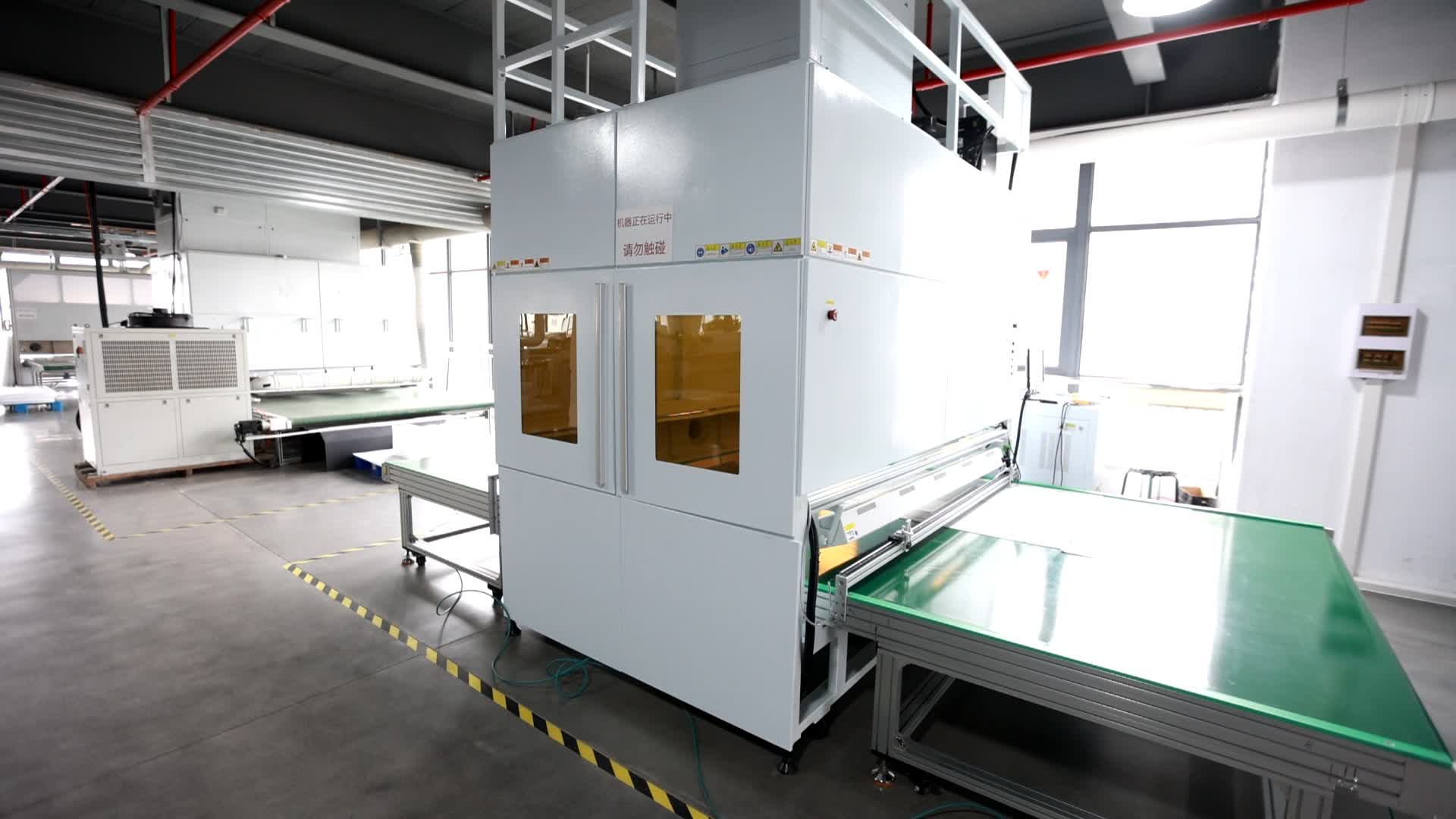
Laser dotting is one of the key processes for controlling light extraction in edge-lit acrylic light guide panels.
High-Brightness and Ultra-Thin Configurations
For advertisers, high brightness light guide panel performance is non-negotiable in bright retail environments. For architects, ultra-thin light guide panel profiles are critical for fitting into ceiling, wall, and furniture details.
These two goals sometimes conflict. Increasing brightness usually means more LEDs or higher drive current, both of which generate more heat. An ultra-thin panel leaves less space for heat dissipation. The supplier must balance brightness, thickness, and thermal management within the system design.
When evaluating custom LGPs, ask for the following data:
- Luminous flux at a defined operating current
- Uniformity ratio (for example, the minimum-to-maximum luminance ratio across the panel)
- Power consumption per square meter at target brightness
- Surface temperature at maximum brightness
- Recommended LED strip type and power supply matching
EDGELIGHT's LGP product is designed for a maximum power of 144W and typical power consumption of 101W. The system is intended to work with LED strip lights and constant current power drivers, as noted in the company's application unit.
Typical Use Cases for Custom Light Guide Panels
Custom LGP systems appear across a wide range of end-use environments. EDGELIGHT's product data lists these applicable industries:
- Retail & luxury display
- Hospitality & commercial interiors
- Exhibition & museum
- Elevator decoration
- Advertising light boxes & signage
- Office & high-end residential
- Transportation & public spaces
- Consumer electronics backlighting
Specific functions include showcase and shelf backlighting, ceiling light panels, ultra-thin LED light boxes, and elevator cabin wall decoration.
Retail and Luxury Shelf Backlighting
In premium retail, a uniform illumination light guide panel turns an ordinary shelf surface into a brand statement. Edge-lit LGPs provide a slim profile that fits behind a shelf or display case, with adjustable color temperature to match the product or brand scene.
Exhibition Walls and Museum Displays
Exhibition spaces often need large, ultra-thin illuminated walls. A custom LGP in a light box frame can deliver even, low-glare light with minimal structural depth. EDGELIGHT's project images include an exhibition entrance wall and luxury window displays.
Elevator Interior Decoration
Elevator cabin walls and ceilings are an unusual but durable application for LGPs. The application must operate reliably in a compact, high-vibration environment and often requires custom printing, texture, and color temperature. EDGELIGHT's case unit includes an elevator manufacturer customer who has purchased more than 10,000 units over 20 years of cooperation, with the product supporting lighting, printing, and customized size and texture.
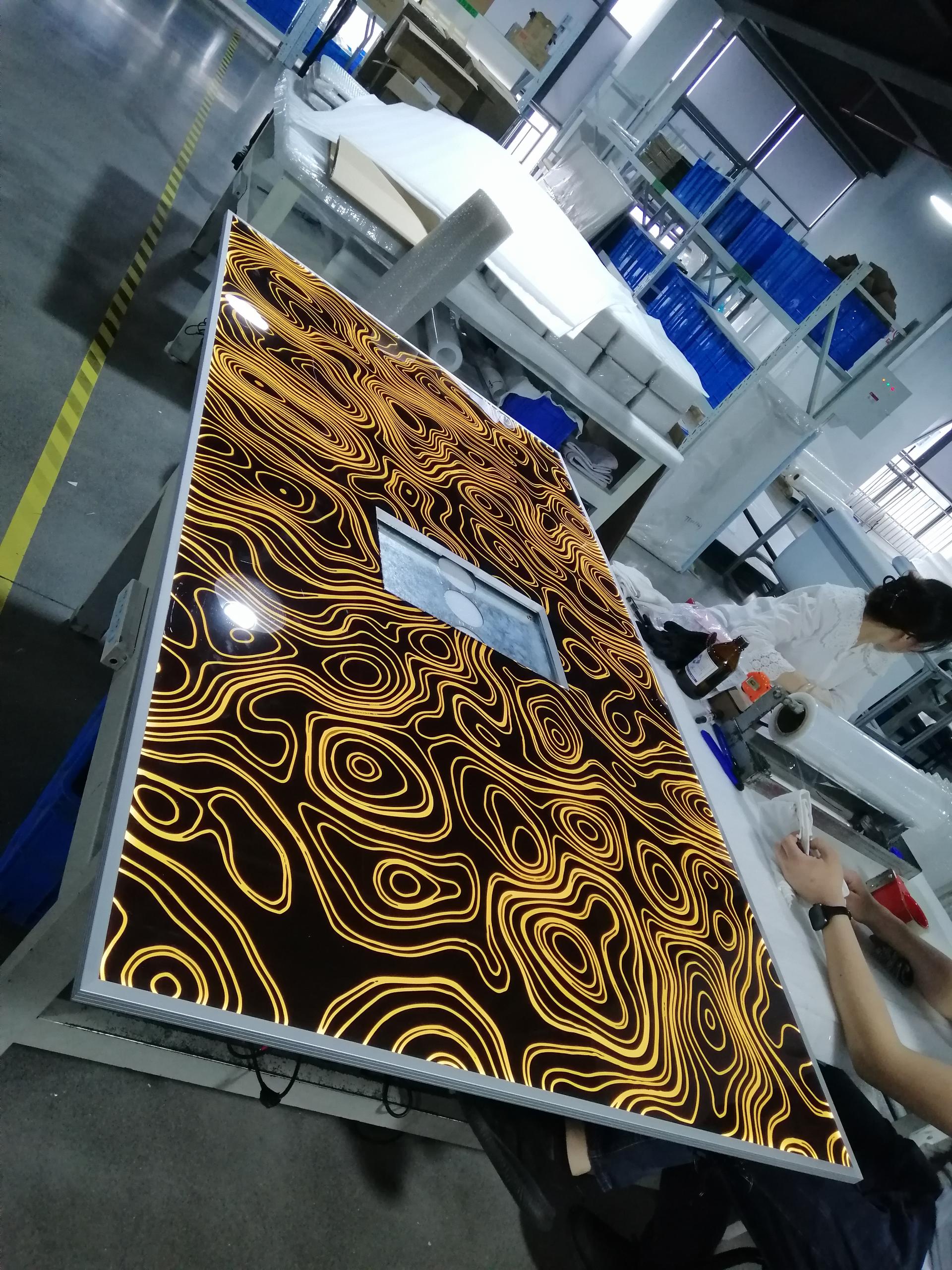
Elevator cabin décor is a long-life application for custom edge-lit LGP panels.
Advertising Light Boxes and Signage
For signage companies, light guide panel for LED light box OEM means a reliable supply chain for a core optical component. Signage requires consistent uniformity, stable color temperature, and dependable logistics. OEM buyers often purchase LGPs cut to size in volume while completing the light box frame in-house.
Quality Control and Supplier Evidence
A serious OEM buyer should verify the factory's quality control system, not just its marketing materials. Useful evidence includes:
- Certificates issued by recognized third-party testing bodies
- Specific certification numbers and standards
- Production line photos and factory descriptions
- Client history and case references
- Inspection process documentation
EDGELIGHT offers verifiable documentation: CE certificate number CTSL2620530156EZ, UL certificate number UL-US-2145621-0, and a 100% test quality control statement. The company also publishes its factory area, production base locations, and product catalog, which supports transparent supplier evaluation.
MOQ, Lead Time, and Sample Strategy
For custom projects, procurement teams need flexibility in MOQ, sample speed, and production lead time.
EDGELIGHT states an MOQ of 1 unit, which is unusually low for a factory of its scale. This allows a client to test a custom size or product concept before committing to volume. Lead time is stated as 5–10 days, with a monthly capacity of 30,000 units for the production mode. Annual output across the company is 120,000 units, with 75% exported to markets such as the USA and EU.
Comparison: What to Evaluate in an LGP Manufacturer
When researching manufacturers, use a comparison framework rather than price alone. The following table lists supplier evaluation criteria commonly used by display and signage buyers. It is not a ranking of specific companies.
| Evaluation Criterion | What to Check | Example Evidence from EDGELIGHT |
|---|---|---|
| Certification | Valid CE, UL, or other market-specific certificates for the target model | CE: EN IEC 55015:2019/A11:2020, cert. CTSL2620530156EZ; UL: UL 2108, 2nd Ed., cert. UL-US-2145621-0 |
| Optical performance | Luminous flux, uniformity, color temperature range | Luminous flux >1080 lm; color temperature 2700K–6500K |
| Customization scope | Size, thickness, brightness, logo, shape, installation structure | OEM/ODM customization including size, thickness, color temperature, logo, surface shape, light output brightness, installation structure |
| Production capability | Factory scale, process equipment, monthly capacity | Laser dotting, UV cutting, printing, SMT lines; monthly capacity 30,000 units |
| Quality control | Inspection process, test coverage | 100% test |
| MOQ and samples | Flexibility for prototypes and small launches | MOQ: 1 unit |
| Lead time | Production speed and supply chain reliability | 5–10 days lead time |
| Export experience | Markets served, local support, logistics | 75% export ratio; main markets USA/EU; local support |
Mitsubishi Chemical Corporation is identified in third-party market research as a leading player in the light guide plate competitive landscape. For most OEM buyers, a comparison should focus on how well a supplier's certification, customization capability, and lead time match the buyer's project constraints.
Industry Context and Market Signals
Third-party research helps buyers understand the broader supply environment. According to Dataintelo, the global Light Guide Plate (LGP) market was valued at USD 3.91 billion in 2025 and is projected to reach USD 6.51 billion by 2034, with an expected CAGR of 5.8% from 2025 to 2034. Asia Pacific accounted for a 48.2% revenue share in 2025, and consumer electronics was the largest application segment at 42.5%.
These figures suggest steady demand for LGP-based display and lighting products. For buyers, the implication is not to chase trends but to choose a manufacturer with sufficient capacity, export experience, and certification depth to support a long-term supply relationship.
According to Fact.MR and CHI MEI Corporation, thin PMMA light guide plate substrates below 2 mm accounted for over 60% of display-grade shipments for major manufacturers in 2024. This confirms the industry trend toward thinner, lighter panels. To achieve a 2–3mm profile, the optical design and production precision must be high. Buyers should confirm the actual achievable thickness and resulting uniformity with the manufacturer.
For market access, standards such as UL 8750 for LED equipment and IEC 60598 for luminaires are commonly referenced. EDGELIGHT's LGP uses UL 2108, a standard specifically for low-voltage lighting systems and sign accessories, and CE EMC standards for the European market. Buyers should map the required certification of their final product to the LGP supplier's certificate scope.
FAQ for Custom Light Guide Panel Buyers
- Q: What certifications should a CE-certified light guide panel manufacturer hold?
- A: For the EU market, a manufacturer should hold CE certification based on the applicable EMC and safety standards. EDGELIGHT's GPF001 light guide panel, for example, is CE certified under EN IEC 55015:2019/A11:2020, with certification number CTSL2620530156EZ issued by CTSL Testing (Dongguan) Co., Ltd. For the US market, the same product family is covered by UL certification under UL 2108, 2nd Ed., number UL-US-2145621-0 issued by UL LLC. Buyers should verify that the certificate includes their target model series and market.
- Q: Can the light guide panel be customized to a specific size and thickness?
- A: Yes. A manufacturer with OEM/ODM capability can adjust size, thickness, color temperature, logo, surface shape, light output brightness, and installation structure. EDGELIGHT, for example, lists these customization options and supports an MOQ of 1 unit, making custom prototypes practical. The final specification should always be validated with a physical sample.
- Q: What is the difference between edge-lit and backlit light guide panels?
- A: An edge-lit light guide panel receives light from LEDs placed along one or more edges, allowing an ultra-thin overall profile and lower power consumption. A backlit light guide panel receives light from LEDs placed behind the panel, which can support higher luminance but generally requires a deeper cavity. The right choice depends on the light box profile, brightness target, and application environment.
- Q: What is a typical MOQ and lead time for a custom LGP order?
- A: This varies by manufacturer and configuration. EDGELIGHT states a 1-unit MOQ and a 5–10 day lead time for its OEM/ODM light guide panel production, with a monthly capacity of 30,000 units. Buyers should confirm current production schedules and shipping time, especially for complex custom dot patterns or large-volume orders.
- Q: How can I evaluate a light guide panel sample before mass production?
- A: Ask the manufacturer to supply a sample that includes the final acrylic material, dot pattern, thickness, and size. Test it with the intended LED strip and power driver, measure uniformity and brightness, and confirm the color temperature is stable under continuous operation. Since EDGELIGHT supports MOQ of 1 unit and 100% testing before shipment, buyers can request a pre-production sample through its official contact channels.
Final Checklist: Before You Place an LGP Order
Use the following checklist to consolidate your procurement requirements:
- Target market and required certifications: CE, UL, UL 8750, IEC 60598, or others
- LGP architecture: edge-lit or backlit
- Active area dimensions and overall dimensions with tolerances
- Thickness target: ultra-thin (2–3mm) or standard
- Material specification: optical-grade acrylic/PMMA, anti-yellowing requirement
- Optical targets: luminous flux, uniformity ratio, color temperature, power consumption
- LED strip type and power driver matching
- Surface finish: printing, texture, logo, mirror edge, or standard
- Frame and installation structure
- Environmental conditions: indoor/outdoor, IP rating, operating temperature
- Sample, MOQ, lead time, packaging, and logistics
- Quality control evidence: test reports, certificates, inspection process
A well-documented specification helps both the buyer and the manufacturer deliver a light guide panel with the right optical performance and compliance.
Next Step: Request a Quotation or Sample
For OEM buyers evaluating custom acrylic LGP supply, the next practical step is to request a quotation or sample for your target size and brightness specification. Shanghai Edgelight Industry Co., Ltd. can be reached at info@edgelight.com or through its official website en.edgelight.com.
Need a Custom Light Guide Panel for Your LED Light Box?
Download the LED product catalog to review the full range of LGP and LED display offerings, or contact the EDGELIGHT team to discuss your custom size, certification, and sample requirements.
Have Questions or Need More Details?
Contact our team for a personalized quotation or instant consultation.
Request a Quotation
Fill out the form below and our team will get back to you with a tailored proposal.
WhatsApp Direct Chat
Prefer to chat in real-time? Message us on WhatsApp for instant assistance & quick answers.
- Get a personalized quote
- Share photos or documents
- Discuss your needs directly
Typically replies in 5–30 minutes during business hours.