
What Is a Light Guide Panel? The Physics Behind Even, Energy-Saving Illumination
A light guide panel (LGP) is a flat optical component that captures light from LEDs mounted along its edge and redistributes that light across the whole front surface as even illumination. The panel does not generate light — it moves it. In the majority of commercial light boxes, signage and display backlights, the panel is made of acrylic (polymethyl methacrylate, or PMMA): a rigid, transparent sheet that carries light internally by total internal reflection and releases it through a pattern of microscopic extraction dots.
That mechanism is not just an academic detail. Once the physics is clear, the numbers on a light guide panel datasheet — luminous flux, power consumption and color temperature — become decision tools rather than line items. They tell a buyer whether a panel will be bright enough for the surface it has to cover, whether the light will be even enough to avoid visible hot spots, and whether an edge-lit design will consume less power than the thicker alternatives it replaces. This guide walks through the mechanism in plain language and translates the verified specifications of the acrylic light guide panel manufactured by Shanghai Edgelight Industry Co., Ltd. (EDGELIGHT) into practical terms.
Problem Definition: Why a Point Light Source Cannot Illuminate a Flat Surface on Its Own
An LED is a near-point source. It emits a large amount of light from a very small area, and it emits that light within a limited angle. Place a bare LED behind a one-metre advertising panel and the result is a bright circle surrounded by darkness.
The intuitive fix — a diffuser plate placed in front of the LEDs — solves only part of the problem. Diffusion spreads light into wider angles; it does not relocate energy. The area directly in front of each emitter still receives far more light than the area between emitters. Smoothing that imbalance with diffusion alone requires more depth, so the beams can overlap, or a denser diffuser, which absorbs light and reduces what finally reaches the viewer.
Three buyer questions follow directly from that limitation, and a light guide panel exists to answer all three:
- Brightness — how much light does the panel deliver across its working area?
- Evenness — how large is the gap between the brightest and the dimmest point on the surface?
- Efficiency — how much electrical input is required to produce the delivered light?
A fourth source of confusion is worth clearing up before any specification is discussed. Color temperature, expressed in Kelvin (K), describes how white the light looks — warm, neutral or cool — not how bright it is. Two panels with identical luminous flux can look completely different once installed. A 2700K panel and a 6500K panel of the same brightness are not interchangeable in a retail fixture or a hospitality interior, because the perceived warmth changes how materials, food and finishes read.
Industry Background: Why Edge-Lit Panels Became the Default for Thin Illumination
Demand for thin, flat, evenly lit surfaces has grown steadily. Third-party research published by Dataintelo values the global light guide plate market at USD 3.91 billion in 2025 and projects USD 6.51 billion by 2034, equivalent to a 5.8% CAGR over the 2025–2034 forecast period. The same research places Asia Pacific at 48.2% of 2025 revenue, valued at USD 1.88 billion, with consumer electronics the largest application segment at a 42.5% share.
The substrate market points in the same direction. PMMA — the acrylic used as the light-carrying substrate in most guide panels — was valued at USD 5.4 billion in 2024 with a 5.6% CAGR, according to USD Analytics. Thin formats have become standard rather than niche: Fact.MR, citing CHI MEI Corporation, reports that PMMA substrates below 2 mm accounted for over 60% of display-grade shipments among major manufacturers in 2024.
Two external forces reinforce the trend:
- Efficiency regulation. The 2024 International Energy Conservation Code (IECC) reduces permitted lighting power allowances, tightening the efficiency expectations placed on LGP-based LED panels in the United States.
- Safety compliance. Panels sold internationally must satisfy frameworks such as UL 8750 for LED equipment and IEC 60598 for luminaires, in addition to regional schemes.
For a buyer, the consequence is straightforward: thin and bright are no longer differentiators by themselves. What separates one panel from another is how much of the LED output reaches the visible surface, and how evenly it is spread — both determined by optical design and manufacturing control.
Detailed Solution: The Four Physics Stages Inside an Acrylic Light Guide Panel
Total internal reflection (TIR) is the effect that makes edge lighting possible. When light inside a transparent material strikes the material boundary at a shallow angle, it is reflected back into the material instead of passing through. Acrylic has a much higher refractive index than air, so the range of angles at which this happens is wide — wide enough that a clean acrylic sheet can trap most of the light entering through its edge.
Stage 1 — Injection at the edge
LEDs are positioned along one or more cut edges of the acrylic sheet, facing the polished edge face. Because the acrylic is optically denser than air, light crossing that boundary bends toward the plane of the sheet rather than escaping immediately. The edge is the entry point for the entire illuminated surface.
Stage 2 — Transport by total internal reflection
Inside the sheet, light repeatedly strikes the top and bottom faces at angles beyond the critical angle and is reflected back inward. This is why a pattern-free light guide panel looks almost like ordinary clear acrylic from the front: the light is inside it, travelling laterally across the panel rather than leaving it.
Stage 3 — Extraction by the dot pattern
If nothing disrupted that internal reflection, the panel would stay dark. The extraction layer — laser-dotted or printed dots applied to one face — does the disrupting. Each dot is a local disturbance that scatters light out of the internal path and through the emission face. Density matters more than the mere presence of dots: because less light remains in the sheet the further it travels from the edge, the extraction pattern is engineered so that the far end releases more light than the near end. That gradient compensates for attenuation and equalizes the surface. It is the single most important uniformity mechanism in an edge-lit panel, and it is also the element most often customized for a specific light box.
Stage 4 — Emission and homogenization
Light leaving the dots is still slightly directional. The extraction pattern, combined with a diffuser layer and a reflective backing layer, is what converts that raw output into a smooth, glare-controlled and visibly uniform surface. In commercial edge-lit construction, the two production routes most often cited for thin panels are profiles of roughly 2.0 mm via injection molding and roughly 3.0 mm via laser dotting.
Why acrylic carries the light
Shanghai Edgelight Industry Co., Ltd. manufactures its light guide panel with acrylic (PMMA) as the substrate. Acrylic supports the TIR mechanism described above, is produced in large flat sheets, cuts and machines cleanly on UV laser equipment, and can be dotted, printed, shaped and drilled without losing optical clarity — which is what makes it possible to customize size, thickness, surface shape and installation structure on the same material platform.
Verified specification of the Edgelight light guide panel (model LGP):
| Specification | Verified value |
|---|---|
| Substrate material | Acrylic (PMMA) |
| Luminous flux | >1080 lm |
| Typical power consumption | 101 W |
| Maximum power / current | 144 W / 7.2 A max |
| Color temperature | 2700K–6500K |
| Operating temperature | −20℃ to 50℃ |
| Protection grade | IP20–IP65 |
Read as a set, these figures describe a panel that delivers more than 1080 lm of luminous flux while drawing 101 W in typical operation and no more than 144 W at up to 7.2 A. Color temperature can be specified anywhere between 2700K and 6500K, and the operating envelope of −20℃ to 50℃ with protection from IP20 to IP65 allows the same platform to serve a climate-controlled indoor display and a more exposed advertising light box.
Step-by-Step Breakdown: How to Read a Light Guide Panel Datasheet
The physics described above maps onto a short, repeatable evaluation sequence. Buyers who follow it in order avoid the most common specification mistakes.
- Start with the light source, not the panel. Luminous flux sets the total light available, and color temperature (2700K–6500K on the Edgelight panel) determines whether the finished installation reads warm or cool. Decide the color temperature before comparing brightness figures.
- Pair flux with power draw. Read the typical and maximum ratings side by side — over 1080 lm at 101 W typical, with a 144 W and 7.2 A maximum. The maximum defines what the driver and the wiring have to handle; the typical figure is what the installation consumes in normal service.
- Match the architecture to the assembly depth. Edge-lit construction is chosen where profile matters, because the light never has to travel forward through an air gap before it reaches the visible surface. This is why edge-lit guide panels dominate slim light boxes and ultra-thin advertising displays.
- Ask how the extraction pattern is made and specified. Laser dotting and printed dotting are the two common routes, and the dotting design determines evenness across the sheet. Request the pattern specification, not just the panel drawing.
- Check the operating environment. Operating temperature (−20℃ to 50℃) and ingress protection (IP20–IP65) decide whether a panel belongs in a climate-controlled display case, a continuously lit elevator car or a semi-exposed light box.
- Verify compliance for the destination market. Ask for the certificate number and the standards list rather than a compliance statement. Edgelight's light guide panel line is documented under a CE EMC certificate and a UL certification record, detailed in the FAQ below.
- Validate with a physical sample. Uniformity, color and mechanical fit cannot be confirmed from a drawing. A pre-shipment test on an actual panel is the only reliable check.
Use Cases: Where the Same Physics Serves Different Requirements
Advertising light boxes and commercial signage
This is the application that made edge-lit panels standard. A slim box needs a bright, even face within minimal depth, and the LGP delivers both: the LED row sits behind the frame edge, and the extraction pattern spreads the light across the printed graphic. Higher brightness is achieved by specifying higher flux and a tighter dotting pattern, not by adding depth.
Retail and luxury display
In shelving, counters and backlit display cabinets, evenness matters more than raw output, because a hot spot is immediately visible against a matte or glossy product. Dot pattern design and diffuser selection do the visible work here.

Elevator decoration
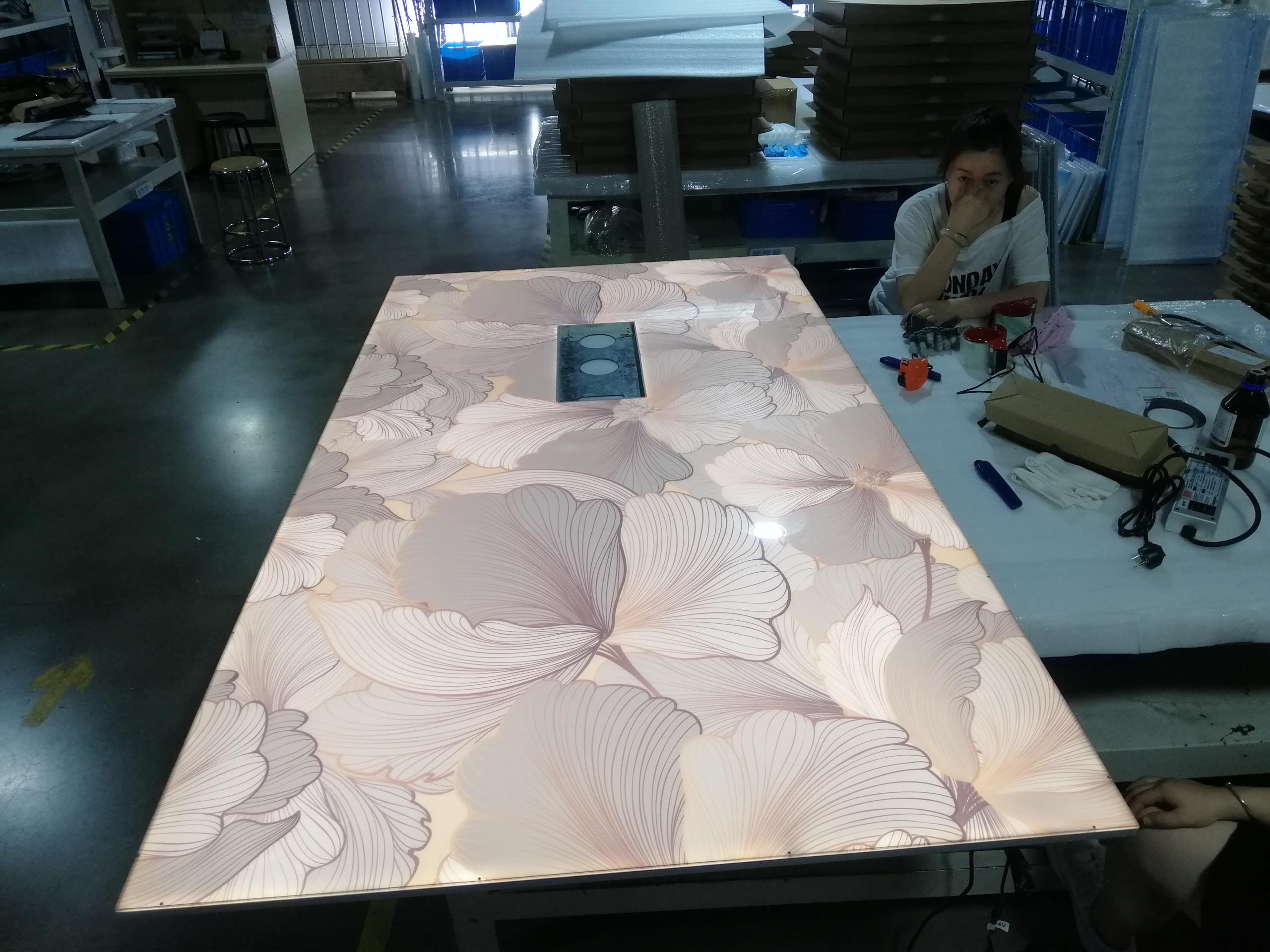
Elevator interiors require light sources that survive continuous duty and constant vibration. One elevator manufacturer has ordered 10,000 units of customized light guide panels for elevator decoration and has worked with the same production relationship for 20 years, with stable operation as the reported result. Customization in that program covered lighting, printed graphics, and customized size and texture.
Other verified application areas
The same panel platform is also applied to hospitality and commercial interiors, exhibition and museum settings, office and high-end residential projects, transportation and public spaces, and consumer electronics backlighting — a breadth that follows from the shared requirement of a thin, even light surface.
Comparison Table: Diffuser-Over-Point-Source vs. Edge-Lit Acrylic Light Guide Panel
The comparison below is a mechanism comparison, not a brand ranking. Both approaches use LEDs; they differ in how light is moved from the source to the visible surface.
| Comparison point | Diffuser over a point light source | Edge-lit acrylic light guide panel |
|---|---|---|
| Light source position | LEDs distributed behind the visible surface | LEDs mounted along one or more cut edges |
| How light reaches the surface | Spread at wider angles; energy is not relocated | Carried laterally inside the acrylic by total internal reflection, then released by the extraction pattern |
| Evenness control | Depends mainly on diffuser opacity and mixing distance | Controlled by dot density and dot pattern gradient along the sheet |
| Assembly profile | Requires depth for the beams to overlap | Ultra-thin construction; publicly documented edge-lit profiles include roughly 2.0 mm via injection molding and roughly 3.0 mm via laser dotting |
| Substrate material | Diffuser plate, application dependent | Acrylic (PMMA) — the substrate used in the Edgelight light guide panel |
| Typical fit | Applications where depth is available and uniformity tolerance is loose | Slim light boxes, signage, display, elevator and interior lighting where evenness and depth both matter |
For an evaluation-stage buyer, the practical takeaway is that the extraction pattern, not the LED count, is the variable worth interrogating. Two panels can use identical LEDs and produce very different surfaces depending on how the dots are designed and produced.
Frequently Asked Questions
Is the Edgelight light guide panel certified for the EU and North American markets?
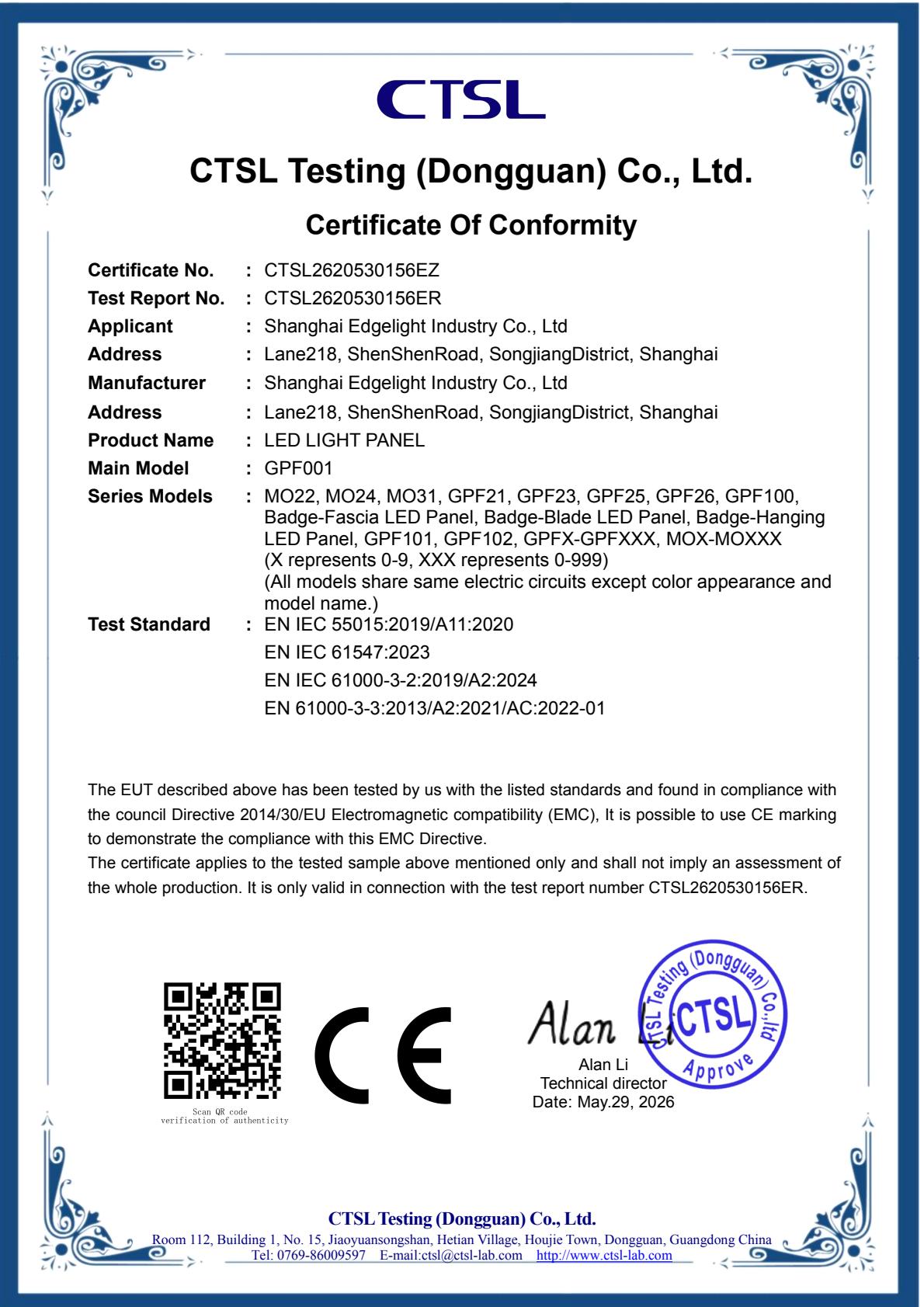
Two sets of documentation cover the main export markets. For the European Union, CE EMC certificate CTSL2620530156EZ was issued by CTSL Testing (Dongguan) Co., Ltd. for the GPF001 series — covering models MO22, MO24, MO31, GPF21, GPF23, GPF25, GPF26, GPF100, GPF101, GPF102 and the GPFX-GPFXXX and MOX-MOXXX variants — tested against EN IEC 55015:2019/A11:2020, EN IEC 61547:2023, EN IEC 61000-3-2:2019/A2:2024 and EN 61000-3-3:2013/A2:2021/AC:2022-01, and issued on 29 May 2026. For North America, the UL record associated with the Edgelight light guide panel line is UL-US-2145621-0, issued by UL LLC under UL 2108 (2nd Edition) and valid to 5 October 2031. Buyers should additionally confirm the framework that applies to their finished product — UL 8750 for LED equipment and IEC 60598 for luminaires are the two most frequently referenced.
What can be customized on a light guide panel for an LED light box OEM project?
OEM and ODM production services are supported with customization technical support across seven variables: size, thickness, color temperature, logo, surface shape, light output brightness and installation structure. In practice, an LED light box project specifies the panel cut to the internal size of the box, in the thickness the frame allows, at a color temperature matched to the graphic or the interior, with printed branding or a logo where required, and with a mounting detail designed around the housing. The substrate is acrylic (PMMA), finished with the dotting or printing pattern that sets the light distribution.
How much power does a light guide panel draw, and how does that relate to running cost?
The verified figures for the Edgelight light guide panel are a typical power consumption of 101 W, a maximum of 144 W at up to 7.2 A, and more than 1080 lm of luminous flux. Energy saving in an edge-lit panel comes from light delivery rather than from a low wattage label: because the light is transported inside the acrylic by total internal reflection instead of being scattered through a deep mixing chamber, a high share of the LED output reaches the visible surface. The comparison that matters is delivered lumens against input watts, at the uniformity the application requires. Buyers in the United States should also note that the 2024 IECC reduces lighting power allowances, which raises the bar for compliant installations.
Can I validate a light guide panel before placing a full order?
Yes. The minimum order quantity is 1 unit, so a single panel can be produced and shipped for evaluation, and every order is subject to a pre-shipment test as part of acceptance inspection, with a 100% test regime applied in production. Customization technical support is available from the sampling stage onward, which means size, thickness, dotting and color temperature can be adjusted on the sample before a larger commitment. The full product catalog can be downloaded here: LED product catalog (PDF).
What is the lead time and production capacity for larger programs?
Typical lead time is 5–10 days, supported by a monthly production capacity of 30,000 units. Edgelight operates five production bases worldwide — the Shanghai headquarters base (approximately 33,000 m²), Tianjin (approximately 20,000 m²), Germany Edgelight GmbH (approximately 1,500 m²), American Edgelight LLC (approximately 1,679 m²) and a second Shanghai factory (approximately 10,000 m²) — and serves the European Union, North America, Southeast Asia and Australia with local after-sales support. To start a quotation, send the panel size, thickness, color temperature and target quantity through en.edgelight.com or to info@edgelight.com.
Conclusion: Even Light Is an Engineering Result, Not a Property of the Material
An acrylic light guide panel works because of four linked physical events: light enters through a polished edge, is trapped and transported inside the sheet by total internal reflection, is released deliberately by a graded extraction pattern, and is then homogenized into a uniform surface. Nothing in that chain depends on how bright the LED is alone — it depends on how the panel manages the light it receives. That is why luminous flux, power draw and color temperature should always be read as a set: more than 1080 lm and 101 W typical on the Edgelight panel describe a delivered result, while 144 W maximum and 7.2 A define what the installation has to support.
For an evaluation or execution-stage buyer, the practical sequence is short: define the color temperature, compare flux and watts together, confirm the extraction pattern design, check the operating and protection envelope, obtain the compliance documentation, and validate a physical sample before scaling. That is the difference between specifying a light guide panel and specifying a light source that happens to sit behind a diffuser.

Request a sample or a quotation
Send your panel size, thickness, color temperature and quantity, and Edgelight will confirm feasibility, tooling and lead time. Samples from 1 unit, pre-shipment testing on every order.
en.edgelight.com · WhatsApp +86 177 0189 1091 · info@edgelight.com
Have Questions or Need More Details?
Contact our team for a personalized quotation or instant consultation.
Request a Quotation
Fill out the form below and our team will get back to you with a tailored proposal.
WhatsApp Direct Chat
Prefer to chat in real-time? Message us on WhatsApp for instant assistance & quick answers.
- Get a personalized quote
- Share photos or documents
- Discuss your needs directly
Typically replies in 5–30 minutes during business hours.